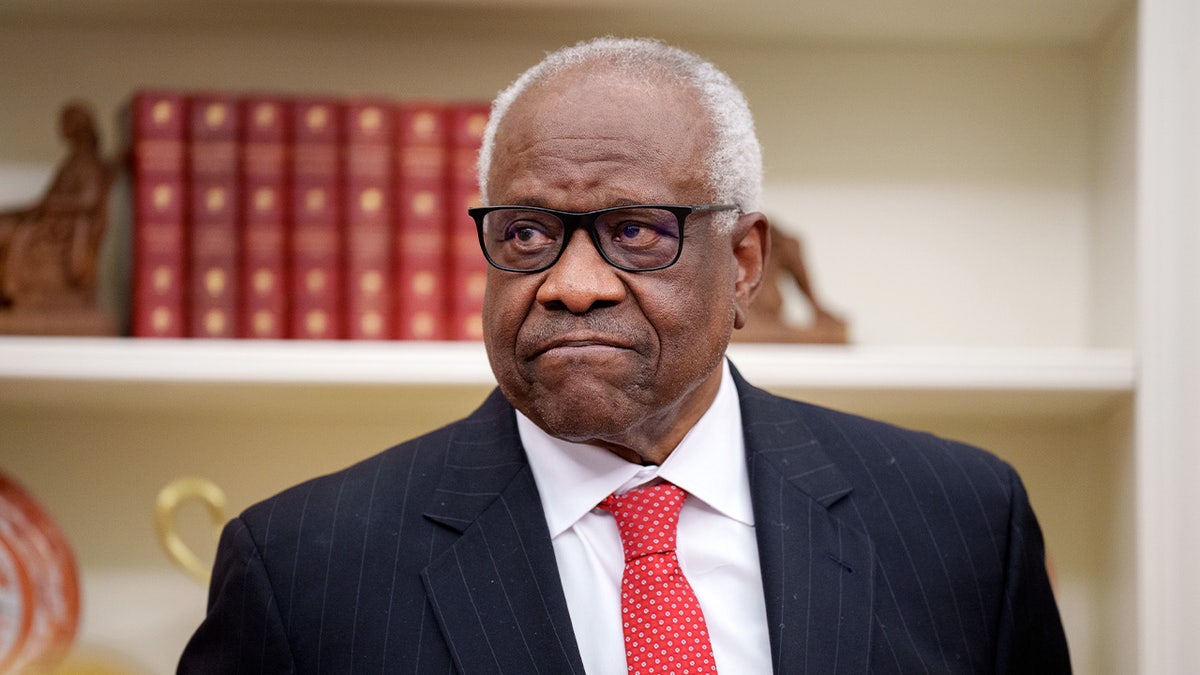

Americans will hear a lot of speeches this year marking the of the , but its hard to imagine anyone topping the one Justice Clarence Thomas delivered at the University of Texas at Austin. If one is inclined to believe that the majesty of our founding documents, and the ideals enshrined therein, still resonate in the hearts of Americans, then Justice Thomass speech was a clarion call to conscience, a summons to the courage and clarity that animated the American Revolution.
Thomas praised Dean Justin Dyer and UTs new School of Civic Leadership, saying it was his sincere hope that their work “to revitalize the teaching and research of Western civilization and the American constitutional tradition will lead the way in the reform of our nations colleges and universities” â a generous note of gratitude for those who labor, often anonymously, in the vineyards of civic virtue.
Thomass reverence for the Declaration of Independence was palpable, as he recounted the audacity of Jeffersons assertion that “all men are created equal.” He reminded his audience that the Declaration is not a relic â an obscure, esoteric, academic plaything to be admired from afar â but a living testament to the capacity of men and women to transcend the ordinary. Its words, Thomas insisted, are an invitation to courage, echoing across centuries to challenge each new generation to defy tyranny and embrace liberty.
Justice Thomas drew upon a pantheon of heroes: the Founders, whose signatures risked lives and fortunes; the soldiers at Valley Forge, whose endurance was measured not only in frozen nights but in the persistence of hope; and leaders of subsequent epochs who refused to yield constitutional principles to expediency. These vignettes, rendered with characteristic sonorous solemnity, served as reminders that the American story is stitched together by seldom celebrated, and courage seldom acknowledged.
Notably, Thomas confronted the failures of the , most pointedly in his critique of Plessy v. Ferguson, the 1896 decision “that endorsed government-enforced racial segregation and validated the Jim Crow South that I grew up in.” He lamented the absence of moral fortitude in those who, rather than uphold the promise of equality, succumbed to the temptations of expedience.
“It could not possibly have taken my Court 60 years,” Thomas intoned, “to know that Plessy was a hideous wrong.” The specter of Plessy hovered as a caution against the abdication of dutyâa lesson as relevant today as in 1896.
In a manner reminiscent of William F. Buckleys skepticism toward progressive utopianism, Thomas issued a warning against . He traced its lineage to a philosophy that prefers the plasticity of government by experts over the stubbornness of constitutional constraints. “Progressivism,” Thomas observed, “seeks to replace the basic premises of the Declaration of Independence, and hence our form of government. It holds that our rights and our dignities come not from God, but from government.” This, he suggested, is the perennial threat to republican liberty: the seductive notion that a well-meaning bureaucracy can supplant the wisdom of the Declaration. To Thomas, progressivism is “retrogressive.”
Yet the speech was not a lament, but a prescription. Thomas called for â a recommitment not merely on ceremonial anniversaries, but in the mundane acts of citizenship and stewardship. It depends upon the willingness of each citizen to defend its ideals, to speak truth, to withstand the easy comforts of silence. There is, Thomas urged, a duty to reject complacency and to embrace the challenge of self-government anew.
As Thomass words settled upon the assembled crowd, one sensed the enduring relevance of his message. The principles of the Declaration remain, in his estimation, both fragile and resilient â fragile if neglected, resilient if cherished. His praise for Dean Dyer and the was not mere ceremony; it was a recognitio