

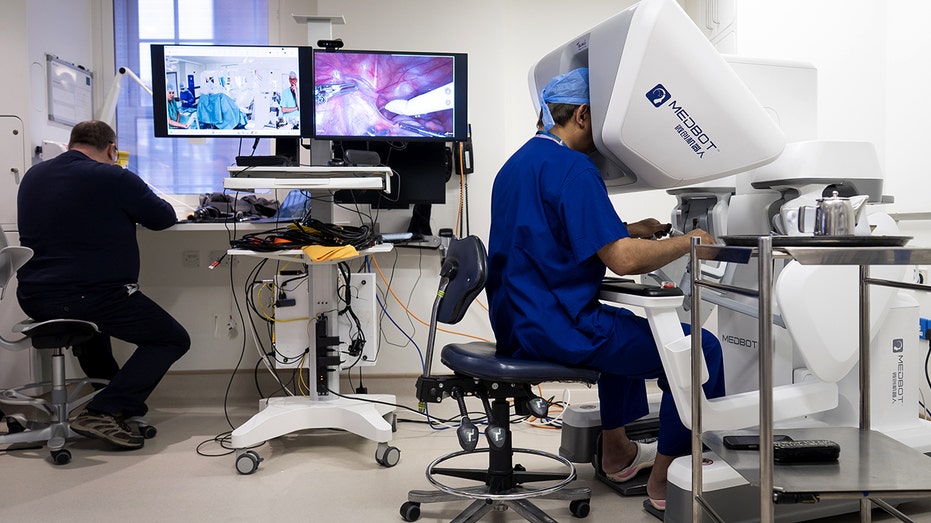

Cancer surgery often requires patients to travel to the specialist. This time, the specialist traveled to the patient. Doctors at The London Clinic remotely guided a robotic system to remove a man’s prostate cancer from 1,500 miles away.
The patient remained in a hospital operating room while the surgeon controlled the procedure from another country. The milestone operation marks the first time a U.K. hospital has successfully performed remote on a patient.
Sign up for my FREE CyberGuy Report
Get my best tech tips, urgent security alerts and exclusive deals delivered straight to your inbox. Plus, youll get instant access to my Ultimate Scam Survival Guide â free when you join my CYBERGUY.COM newsletter.
The procedure connected two hospitals nearly 1,500 miles apart. The surgeon, Professor Prokar Dasgupta, operated from a at The London Clinic’s robotic center at Harley Street.
Â
The patient lay in an operating room at St Bernard’s Hospital. Between them sat an advanced surgical robot. The system used was the Toumai robotic surgical system developed by MicroPort MedBot, a platform designed for high-precision minimally invasive procedures.
From the console in London, Dasgupta controlled:
Fiber optic networks carried every movement from the surgeon’s hands to the robot in Gibraltar. A secure network infrastructure designed by Presidio connected the two hospitals. The delay between command and movement was about 48 milliseconds, which is fast enough to feel almost real time.
For delicate procedures like prostate cancer surgery, that speed really matters. Urological surgeons James Allen and Paul Hughes were part of the local surgical team in Gibraltar, ready to step in if the connection dropped or complications occurred. The operation went smoothly.
The patient, Paul Buxton, is a 62-year-old resident of Gibraltar who has lived there for about four decades. Patients who need specialized often travel to larger medical centers such as London or Madrid. That journey can mean long waiting lists, travel costs and weeks away from home.
Buxton avoided that disruption. He received the procedure in his local hospital. He had originally planned to travel to London for surgery but was offered the chance to participate in a telesurgery trial between the two hospitals earlier in February. Reports say he felt fantastic within days. The technology removed a major burden for him and allowed him to recover close to home.
This operation did not appear overnight. Remote robotic surgery has been developing for decades. One of the earliest examples took place during the Lindbergh Operation. In that procedure, surgeons in New York remotely removed a patient’s gallbladder in Strasbourg, France.
Â
Technology has improved dramatically since then. Recent developments include cross-continent robotic surgeries between Rome and Beijing. Surgeons have also completed long-distance prostate operations using the same Toumai platform in parts of Africa. The London Clinic procedure signals an important shift. Remote robotic surgery is moving from experimental demonstrations toward practical medical use.
The hospitals plan to demonstrate the technology further by live-streaming a telesurgery procedure to thousands of surgeons at the upcoming European Association of Urology Congress.
Several technologies work together to make remote surgery viable.
Surgeons must see and react instantly during an operation. Even small delays can make precise movements difficult. Modern fiber optic networks and backup help keep latency extremely low.
Robotic surgical systems translate a surgeon’s hand movements into smaller and more stable movements inside the patient’s body. That precision often improves outcomes in delicate procedures such as prostate cancer removal.
High-definition 3D cameras allow surgeons to see the surgical area wit


